

Inspect
Pre-purchase drainage inspection
Camera footage of the buried drains around a house you want to buy, a grading review and a written report to help you decide on subjects.
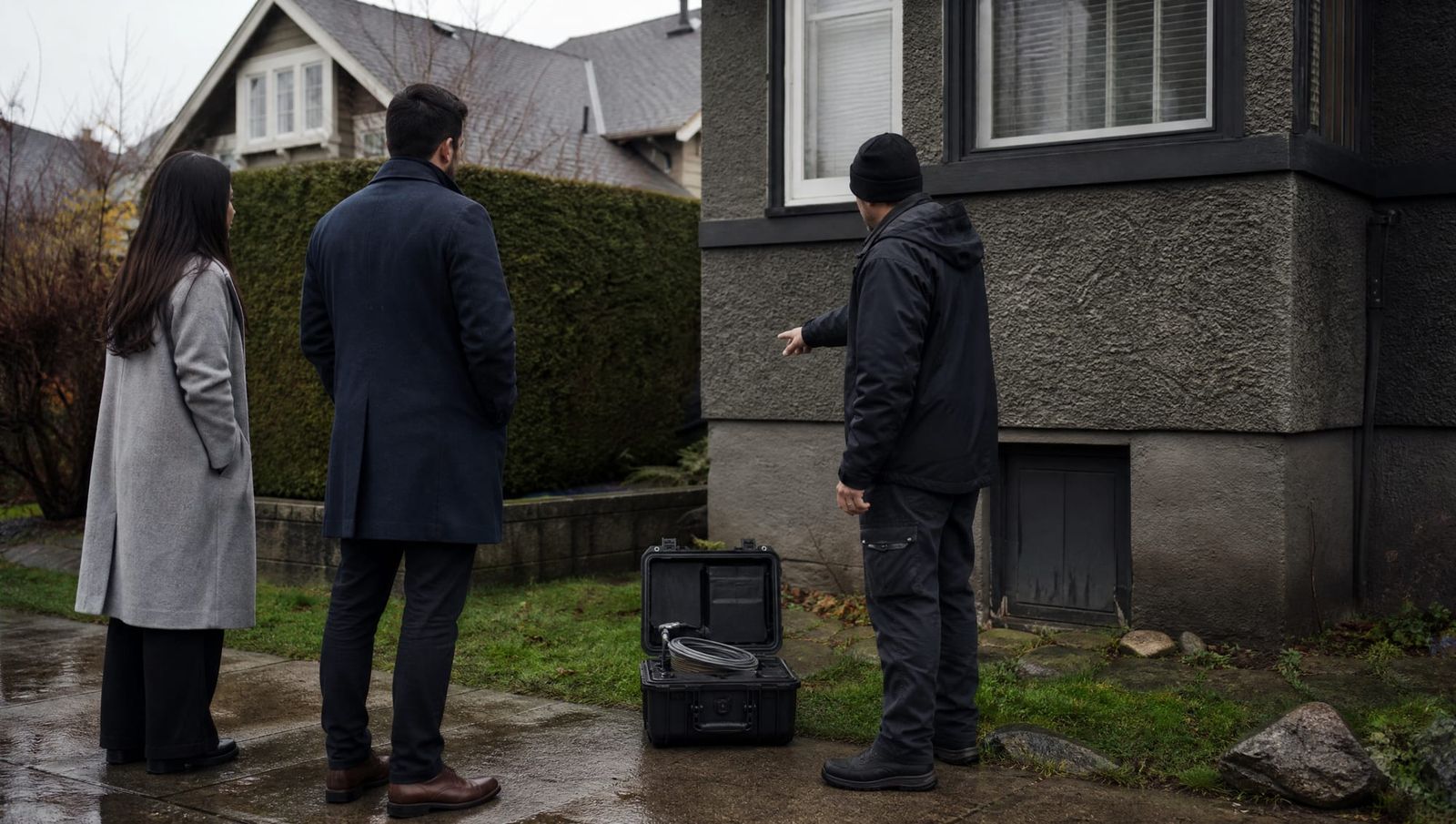
A standard home inspection cannot evaluate what is buried around your foundation. Underground drains need a camera and locating equipment most home inspectors do not carry. A dedicated drainage inspection checks the perimeter and storm lines before you remove subjects, so you know the real condition of the property, not just what is visible above ground.
By the Drainage Pro team Published Updated
A general home inspection is a visual, non-invasive review of the things an inspector can see and reach: the roof, attic, electrical panel, plumbing fixtures, furnace, windows, and the visible parts of the foundation. It is a valuable, broad check of the home's condition above ground and at the surface.
What it does not cover is what is buried. Perimeter drains, footing drains and storm connections sit underground, beside the footing and under the landscaping; for a primer on the system itself, see what a perimeter drain is and how it works. Evaluating them requires a drain camera and, often, underground utility locating equipment that a general home inspector does not carry as standard kit.
That gap matters because drainage is one of the most expensive systems to replace if it has failed, and it is completely invisible from a walkthrough. A home can pass a standard inspection with no comments on drainage and still have a collapsed clay tile system a short distance under the lawn.
This is not a shortcoming in a general inspector's work. Standard home inspections are visual and non-invasive by design, and digging or running a camera through someone else's property before you own it falls outside that scope. Drainage needs a specialist for the same reason a roof inspection sometimes calls in a roofer: the general inspection tells you where to look closer, not the final word on what is underground.
A pre-purchase drainage inspection is built specifically to answer the question a general inspection cannot. It starts with a site walk-through and grading review, then moves underground.
HD drain camera inspection of the accessible perimeter and storm lines, and the sewer line where access allows, along with an evaluation of catch basins and storm drainage, forms the core of the visit. We add underground utility locating where we need to confirm exactly what runs where, plus foundation drainage and hydrostatic pressure observations.
You receive a written findings report with photographs and video, an assessment of the drainage system's age and material, and repair recommendations with realistic budget guidance.
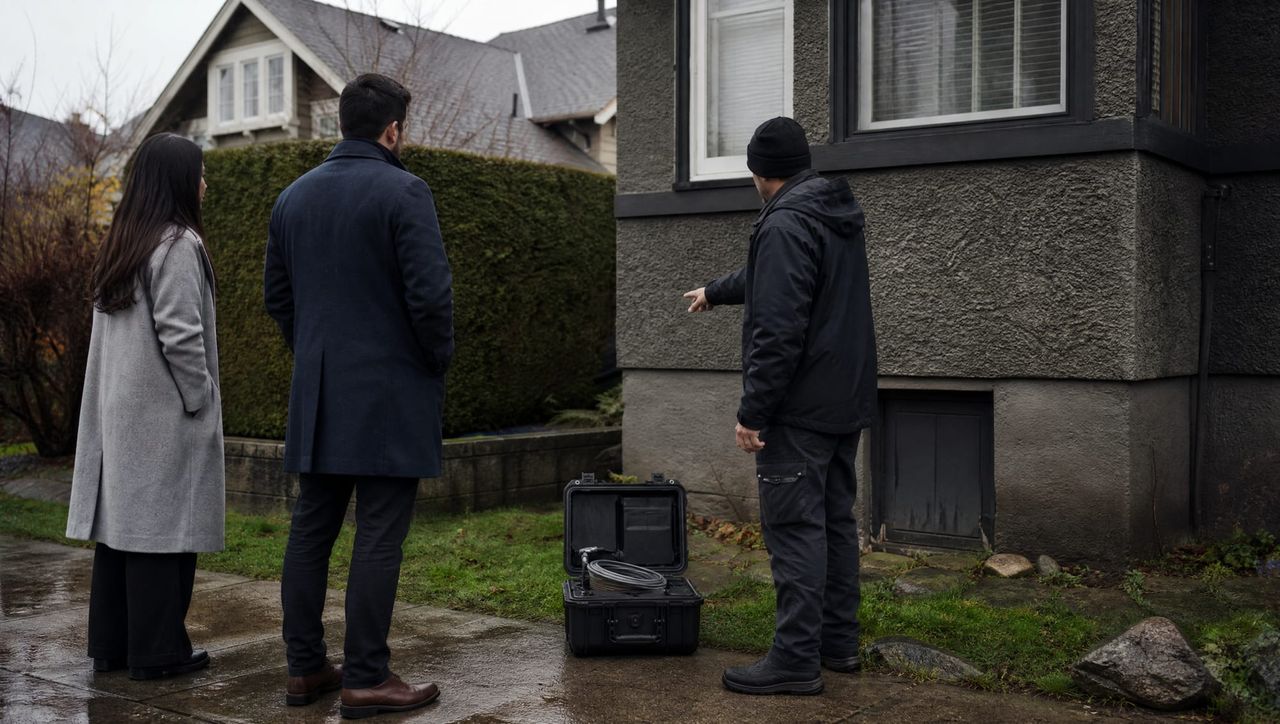
In the standard BC Contract of Purchase and Sale, the contract ends if a subject is not removed in writing by the subject-removal deadline, as the British Columbia Real Estate Association's note on subject removal explains. That deadline does not move for drainage.
Book as soon as your offer is accepted. Most pre-purchase drainage inspections take one to two hours on site, depending on the size of the property and how accessible the drainage system is, but scheduling, the site visit and the written report all need to happen inside the subject period, and subject-removal timelines in this market are often tight.
The tighter the subject-removal window, the more it helps to have your realtor request the inspection on the day the offer is accepted, rather than waiting to see how the general home inspection turns out first.
A clean camera inspection is worth having in hand even when it changes nothing, because it lets you remove subjects with confidence instead of a guess. When the news is not clean, the report is what turns a vague worry into a specific, priced conversation.
A written report with photos and video showing root intrusion, collapsed sections or a drainage system past its expected service life gives you and your realtor something concrete to negotiate with: a price adjustment, a seller-paid repair before closing, or a holdback of funds in trust until the work is done.
Without that documentation, a drainage problem discovered after closing is entirely yours to fund, on your own timeline, with nothing left to negotiate.
Older homes are the obvious flag. A home built before about 1970 likely still has its original clay or concrete drain tile, a system with a 50 to 60 year expected service life that is now at or past that mark in most cases. See our comparison of clay, Big-O and PVC drain tile for how to spot which one a home has.
Finished or recently finished basements deserve extra attention, not less. A basement that was refinished shortly before listing can hide water staining, efflorescence or a musty smell behind new drywall and flooring, and cosmetic work is sometimes done to cover a drainage problem rather than fix it.
Homes on sloped lots, common across the North Shore and parts of Vancouver, see more hydrostatic pressure against the uphill foundation wall than homes on flat ground. Combine any of these factors, an older home, a recently finished basement, or a sloped lot, and a drainage inspection moves from optional to close to essential.
Estate sales and long-held family homes carry their own flag. A property with one owner for thirty or forty years may never have had its drainage inspected at all, simply because nothing ever prompted it, which means the system's true condition is unknown rather than confirmed good.
Subject-removal timelines in this market are often tight, and scheduling, the site visit and the written report all need to fit inside that window.
Realtors can book Drainage Pro directly by phone or through book an inspection; the fastest bookings happen on the day subjects are written into an accepted offer. Send us the address, the subject-removal date, and access details such as a lockbox code or a scheduled showing window, and we will work backward from your deadline.
A copy of the property disclosure statement and any prior inspection or drainage reports, if the seller has them, helps us focus the camera run on anything already flagged. None of that is required to book, but it saves time on site.
A few other details speed things up: whether the crawl space and exterior access points are unlocked, where the cleanouts are if anyone knows, and any water intrusion the seller has already disclosed. We work with whatever access the showing schedule allows either way.
You get a written report with photos and video, plus a call to walk through the findings before you decide.
An inspection is a snapshot, not a warranty. A system that tests clean on closing day can still be old enough that it is worth planning for, and if new symptoms show up after you move in, our guide to signs your perimeter drains are failing explains what to watch for.
If we found issues during the pre-purchase inspection, drain tile repair or a full perimeter drainage replacement addresses them on your timeline rather than in an emergency. If everything tested clean, a camera pass in later years can show whether anything has changed; how often depends on the pipe, the trees near it and the house's history.
Tell us the address and what you're seeing — a backup, a wet wall, a smell, a sinking lawn. We'll tell you what the next step is and what it costs, before anyone digs. Not sure yet? Ask us a question first.
Filed under: buying a home, inspections
It helps, but it only shows the system on the day it was filmed. Send it with your booking so we can check anything it flagged, and treat what it did not cover as unknown until a camera has been through the line.
As soon as possible. Subject-removal timelines in this market are often tight, and scheduling, the site visit and the written report all need to fit inside that window. Booking on the day your offer is accepted gives you the most room to act on the findings.
An HD camera inspection of the accessible perimeter and storm lines, sewer inspection where access allows (sometimes called a sewer scope), catch basin and storm drainage evaluation, underground utility locating when needed, and foundation observations, all documented in a written report with photos, video and budget guidance.
No. A clean camera run shows the pipe's condition on the day of the inspection. An older system can test clean and still be worth planning for, which is why the report also covers its age and material.
Inspect
Camera footage of the buried drains around a house you want to buy, a grading review and a written report to help you decide on subjects.
Inspect
HD video of what is inside your drain and sewer lines, with faults located from the surface, so repairs start from evidence.
Repair
Spot repair, one side or full renewal, scoped from camera footage of your drain tile and the age of the pipe around it.
More guides from the crew that does the digging
Browse all drainage guidesTalk to the crew
Mon–Fri 7:30am–5pm · Sat–Sun 8am–5pm
Water where it should not be? A person answers, not a call centre. Photos by text tell us the most.
Call (604) 210-3892 Fastest way to reach us Text us Send photos of the wet spot