

Inspect
Drain camera inspection
HD video of what is inside your drain and sewer lines, with faults located from the surface, so repairs start from evidence.
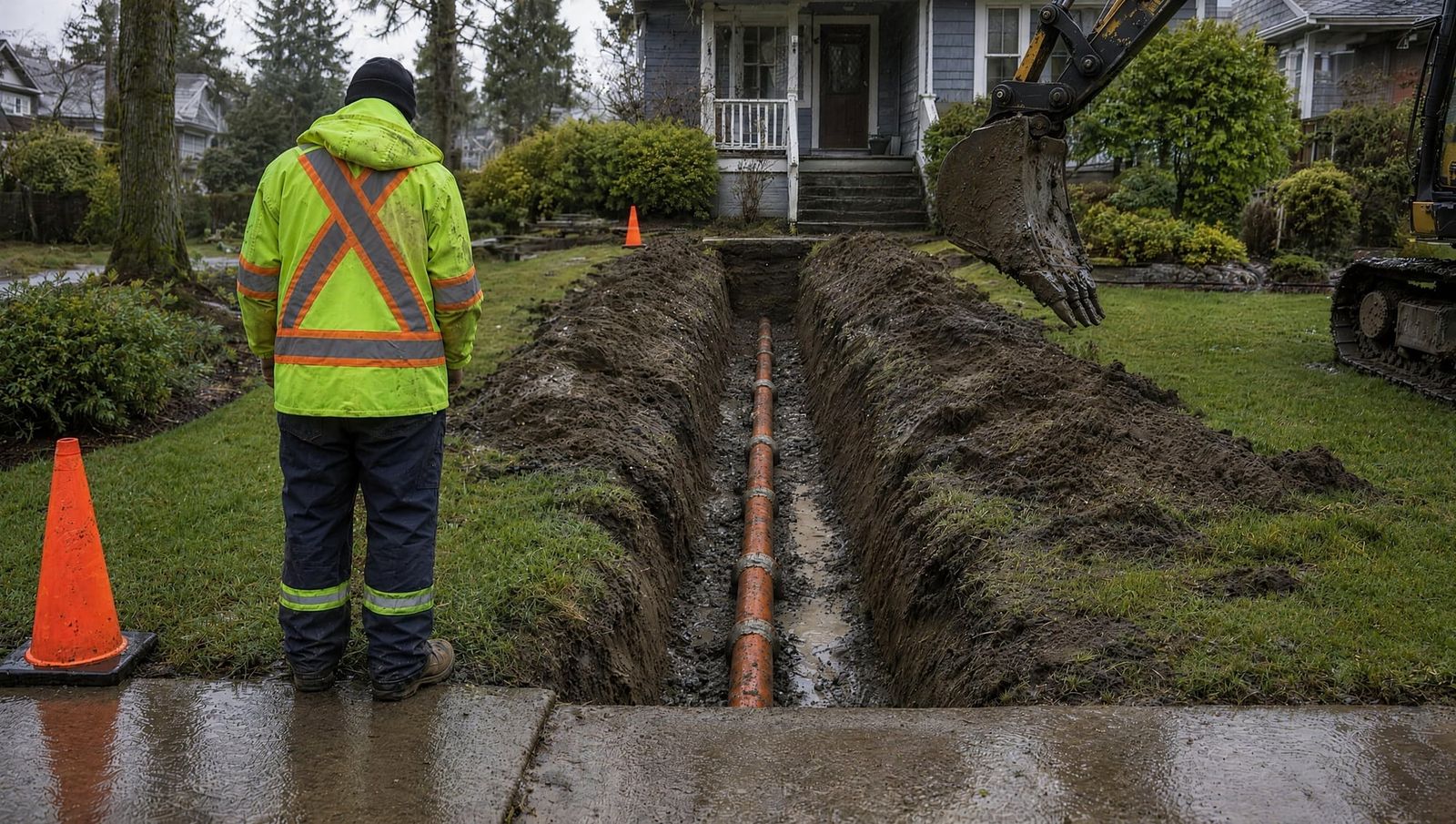
Your sewer line is the private pipe from your house to the city connection, and when it fails there are only three honest fixes — clear it, replace a section, or replace the run. Anyone who tells you otherwise is selling something. We camera the line first, show you the footage, and quote the one fix it actually needs.
A failing sewer line usually gives warning, and the warning is easy to blame on something else: a slow sink, a wet patch, a smell. Any one of these is reason to camera the line before it becomes a backup.
The sewer line is buried, so you cannot judge it by looking. A camera run before you remove subjects gives you something concrete to negotiate with. See our pre-purchase drainage inspection.
Whether your sewer line needs a spot repair or a full replacement depends on how it has failed. A camera inspection shows us what is happening underground — and what will actually fix it.
Your home's age is a useful clue, not a guarantee. A camera inspection identifies the pipe material and its condition.
| Era | Typical material | What to know |
|---|---|---|
| Before 1950 | Clay, some cast iron | Clay comes in short lengths with a joint every metre or so; roots and offsets happen at the joints. Cast iron rusts and scales from the inside. |
| 1950s–1960s | Asbestos cement, clay | Brittle. It cracks under load and the inside wears away over time; sections crumble rather than bend. Removal is handled as an asbestos-containing material. |
| 1970s | Mixed: clay, early ABS | Depends on the builder. The camera settles it. |
| 1980s on | ABS | Smooth-walled with glued joints, so roots have few ways in. Failures are usually a crack or a crushed section from load. Under a driveway or other heavy load the line should be CSA-rated ABS DWV, not thin-wall sewer pipe. |
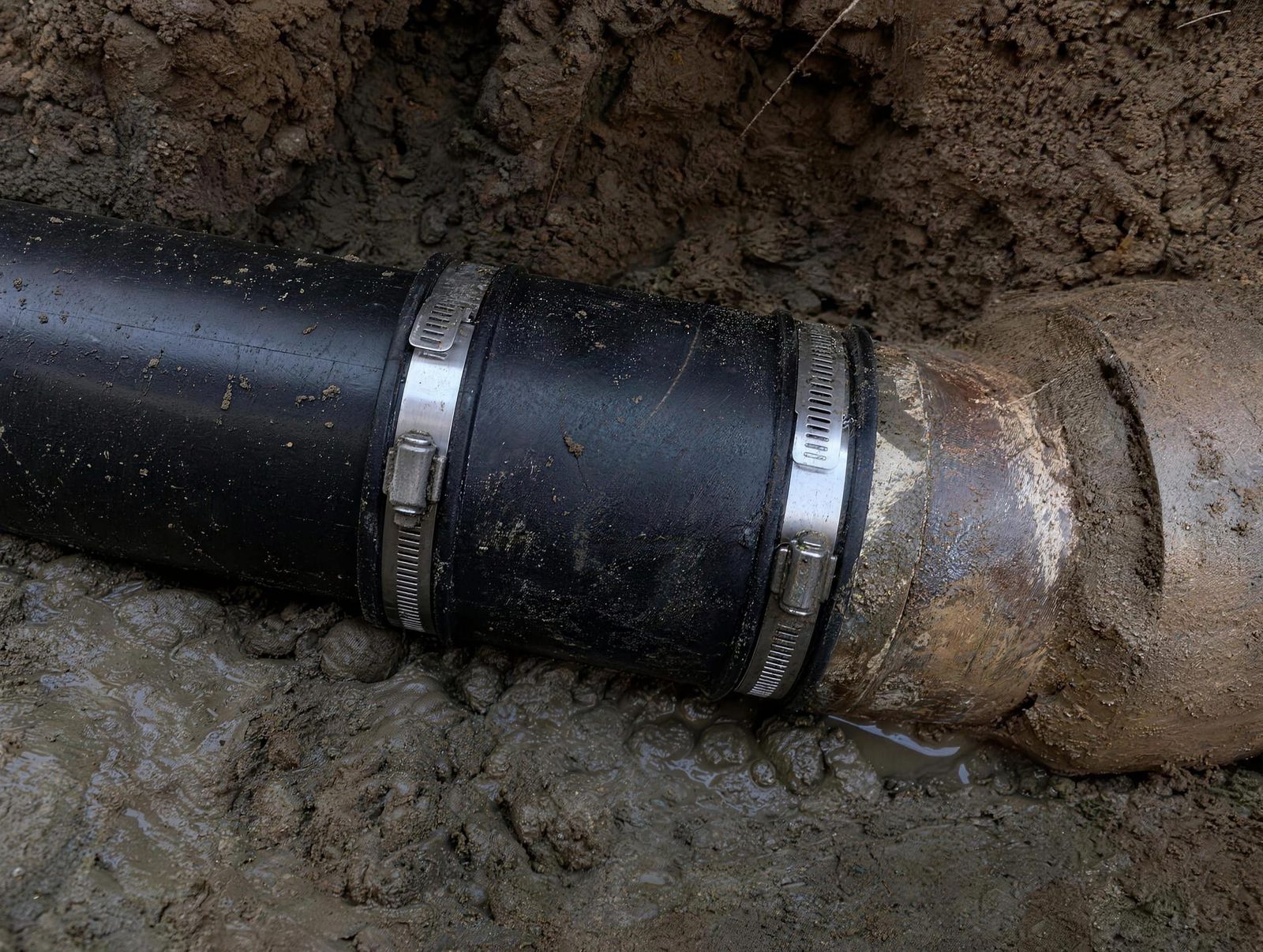
Covered by our Built Better Warranty.
See details of the Built Better WarrantyClear it.
Replace the bad section.
Replace the whole line.
We camera the full line before we quote and mark where each problem is and how deep. You keep the video and written findings whether or not we do the repair, and photos of the open trench and new pipe if we do.
Depth.
How much of the run failed.
What's on top of it.
Which side of the property line.
Permits and inspections.
Putting the ground back.
Scope and price in writing before work starts, including what happens if we find more than the camera showed.
The sewer line from your house to the property line is yours. From the property line to the main is the municipality's, and only their crews or contractors work on it. Most homeowners find this out when the line fails and the city says the problem is on their side.
Every municipality we work in sets it the same way, with small differences in where the handover point sits: District of North Vancouver (Sewer Bylaw 6656), City of North Vancouver (Bylaw 6746), West Vancouver (Bylaw 5263 — the handover is at the inspection chamber if there is one), Burnaby (Sewer Connection Bylaw 1961) and Vancouver (see our Vancouver drainage page).
We confirm where your line ends before we quote.
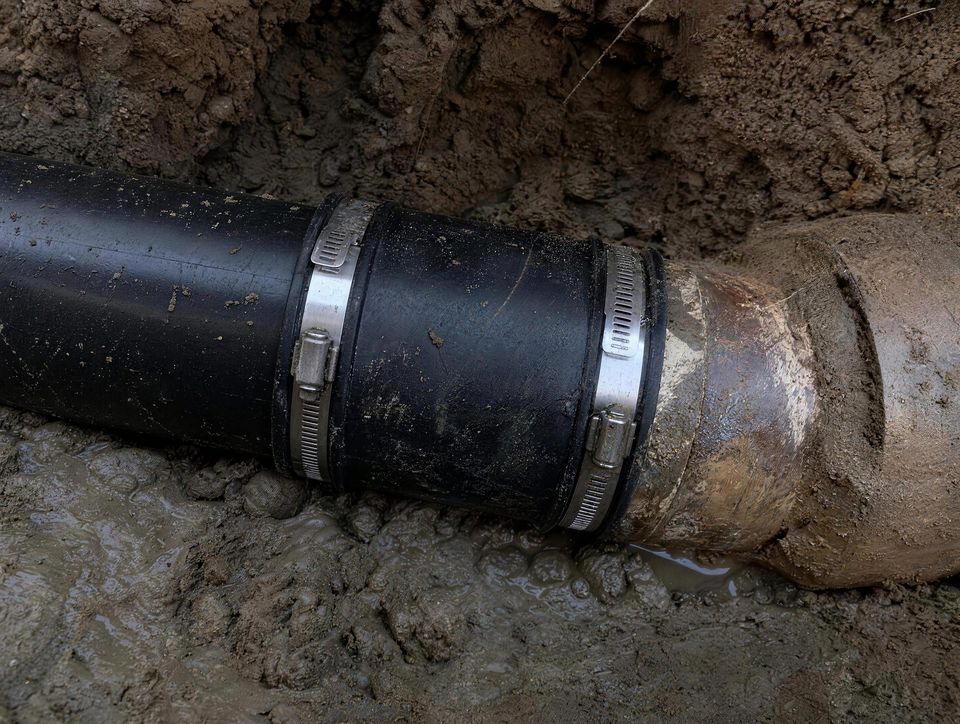
Your sewer line is for sewage only. Gutter downspouts, the foundation drains around your house and the sump pump are supposed to run to the storm drain, not the sewer. On older homes they are sometimes connected to the sewer anyway — the municipality calls this a cross-connection — and they now have to be separated. A sewer line that only backs up during heavy rain is often carrying rainwater it was never meant to.
When the camera finds a downspout or foundation drain tied into the sewer, we'll show you and quote the separation. See perimeter drainage repair and sump pump installation and repair for the systems that carry rainwater where it should go.
One camera run tells you what failed, where, and how deep. You keep the video either way.
Inspect
HD video of what is inside your drain and sewer lines, with faults located from the surface, so repairs start from evidence.
Repair
Drain cleaning for sewer lines and hydro jetting for perimeter drains, with the camera showing what is blocking the line and whether cleaning will hold.
Repair
Spot repair, one side or full renewal, scoped from camera footage of your drain tile and the age of the pipe around it.
Related reading
Guide ·
A standard home inspection cannot evaluate buried perimeter drains. Here is what a drainage inspection covers before you remove subjects in Vancouver.
Usually at the property line, or at an inspection chamber near it. Each municipality sets the exact point in its bylaws, so the answer at your address can differ from a house in another city. Past that point the pipe is the municipality's. We confirm with the municipality where the private sewer line ends at your address.
That pipe is usually the municipality's, so the repair is not a private job. In the District of North Vancouver, only District employees or its contractors work on the municipal connection unless the Director allows a private contractor case by case. The footage, with each defect marked at the surface, shows which side of the line it sits on.
No. A single located defect can mean opening the ground at that spot only, while an open-cut replacement of the whole private run opens it along its length. A sag needs digging, because the grade has to be re-cut. We don't line sewers or install trenchless systems. It isn't accurate and it doesn't hold on this pipe.
Policies vary, so ask your insurer before you assume. Sewer backup cover is usually an optional add-on. Most policies treat a worn-out drain as maintenance rather than a sudden event. We don't advise on coverage.
Homes built before 1950 usually have clay, with some cast iron. Lines from the 1950s and 1960s are often asbestos cement or clay, the 1970s are a mix of clay and early ABS, and from the 1980s on the line is usually ABS. Your home's age is a useful clue, not a guarantee, so a camera run confirms what is in your yard.
No. The sewer lateral carries the house's sewage under the yard to the municipal connection. The perimeter drain sits outside the foundation wall, beside the footing, and relieves the water pressure that builds up against the wall. They do different jobs, though in some older houses the foundation drain was connected to the sewer line.
A cleanout is a capped access point on the sewer lateral. A camera, a rod or a flush can reach the line through it without digging. Where a line has no cleanout, access has to be planned before a camera can go in.
Reviewed
Tell us the address and what you're seeing — a backup, a wet wall, a smell, a sinking lawn. We'll tell you what the next step is and what it costs, before anyone digs. Not sure yet? Ask us a question first.
Talk to the crew
Mon–Fri 7:30am–5pm · Sat–Sun 8am–5pm
Water where it should not be? A person answers, not a call centre. Photos by text tell us the most.
Call (604) 210-3892 Fastest way to reach us Text us Send photos of the wet spot